

Welcome to my blog! For me, some palettes don’t describe a place.
They describe a condition of light.
This palette belongs to that category. It feels like a scene after sunset has fully passed, when color no longer reflects brightness, but instead absorbs it.
It is a study in depth, shadow, and muted intensity. A palette where warmth and darkness coexist without canceling each other out.
PIN IT FOR LATER 📌

© by Altınay Dinç @ Unsplash // unsplash.com
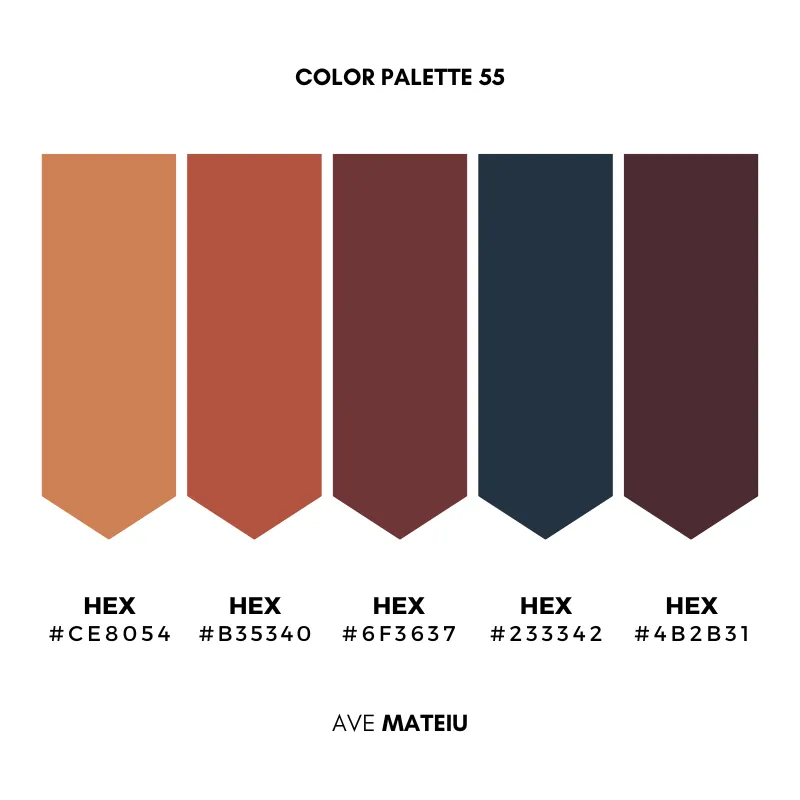
Burnt Ember Ochre #CE8054
The lightest tone in the palette still carries weight.
Best for: This is not a bright highlight color. It feels aged, softened, and slightly faded by time. It works best as a controlled accent rather than a dominant surface, adding warmth without breaking the overall gravity of the palette.
Rusted Clay Red #B35340
This is the first clearly expressive tone.
Best for: It carries warmth, but it’s restrained. There is an earthy undertone that prevents it from feeling loud. In design, it works well when a subtle focal point is needed without introducing visual noise.
Deep Crimson Earth #6F3637
Here the palette begins to shift into shadow territory.
Best for: This color feels grounded and heavy. It functions as a structural tone, useful for anchoring composition, defining contrast, and introducing depth without relying on pure black.
Midnight Blue Grey #233342
This is the cooling counterbalance.
Best for: It pulls the palette away from warmth and introduces distance. It behaves like architectural shadow, creating separation between elements while maintaining coherence with the darker reds.
Dark Plum Shadow #4B2B31
The deepest tone in the set.
Best for: It sits between purple and brown, absorbing light rather than reflecting it. This color is ideal for establishing hierarchy, framing, and creating visual containment within a composition.
Why These Colors Work Together
This palette doesn’t rely on brightness to create structure.
It relies on temperature contrast within low light.
Warm earthy reds interact with cool deep blues in a controlled tension. Nothing is neutral, yet nothing is excessive. The result is a palette that feels stable, cinematic, and visually grounded.
The Feeling Behind the Palette
If earlier palettes described openness and transition, this one describes atmosphere after resolution.
It feels contained.
Focused.
Slightly heavy in a deliberate way.
There is a sense of distance within it, as if the colors exist behind a thin layer of haze.
This makes it particularly suitable for work that needs depth rather than clarity alone. Designs built with this palette feel intentional, structured, and visually anchored.
xxAve
Leave a comment